
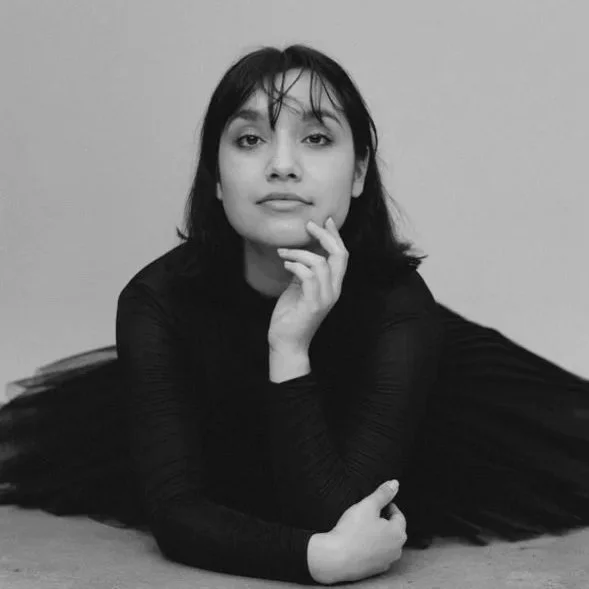
Tabata Vara is a choreographer, performer, and the founder of Totema Dance. Her work investigates identity, memory, and the ways we carry our histories in our bodies. She is drawn to the more complex, less comfortable parts of human experience, not for provocation, but because those are the places where meaningful questions live.
She began dancing at eighteen, training across multiple forms before earning a BFA in Dance Performance and Choreography from Towson University in 2022, where she received the Outstanding Achievement in Choreography Award. At Towson, she studied under Catherine Horta Hayden, Vincent Thomas, Alison Sidenstricker, Runqiao Du, Linda Fisher-Harell, and others who shaped her approach to movement and meaning. She also trained at Washington Ballet and Maryland Youth Ballet with Stuart Loungway, Susan Gresko, and Julie Miles.
In 2023, she was invited to present her work Immolatio at the Attune Dance Festival in Kyoto, Japan, and led a creative movement workshop for children at Shinpukuji Temple.
In 2024, she was commissioned by the Latinx Movement Festival in Washington, DC, where she co-choreographed Café Con Pan with Angel Ramirez, a piece about friendship and resilience. That same year, she was commissioned by the LMP Collective to create Los Pecados De Nuestros Padres, a solo exploring generational trauma. She presented an excerpt of the work as part of THREADS, a free community presentation in Alexandria Virginia.
In 2025, she performed another excerpt of Los Pecados De Nuestros Padres at Dance Place's New Release Festival. Later that year, she presented the same piece in Angel Ramirez's evening-length festival Where I Belong, a program that highlighted immigrant narratives.
In 2026, she was commissioned to present APO for Dance Place's District Choreographers Festival.
Alongside her choreographic work, she co-developed a free bilingual ballet program for low-income families at the William Ramsay Rec Center, where she taught in Spanish and worked to remove barriers to accessing the arts, grounded in her belief that movement provides a universal language.
Totema Dance is the container for this work, not a brand, just a name for the questions I keep asking. At the heart of it is my belief that art's greatest power lies in its ability to connect, include, and revolutionize.